
How Longfin (Butterfly) Koi Are Judged | Finnage, Balance & Standards
Posted by Kloubec Koi Farm on 16th Jan 2026
How Longfin (Butterfly) Koi Are Judged: Understanding Balance, Finnage, and Proportion
Longfin koi—often called butterfly koi—have become a permanent and respected part of the koi hobby. While their flowing fins and elegant movement immediately distinguish them from traditional Nishikigoi, these same characteristics also require a different approach when it comes to evaluation and judging.
Over time, breeders, judges, and hobbyists have worked to refine how longfin koi are assessed so they are judged fairly, consistently, and with respect to what makes them unique. Understanding these principles helps buyers select better fish, exhibitors prepare for shows, and breeders continue improving the variety.
This article provides an overview of the key concepts used when judging longfin koi, with a focus on balance, proportion, and overall quality rather than fin length alone.
Why Longfin Koi Are Judged Differently
Although longfin koi share many traits with traditional koi, they are not simply “koi with long fins.” The defining feature of longfin koi is their finnage, and that feature must be evaluated as part of the whole fish.
Judging longfin koi places additional emphasis on how fins complement body structure, movement, and variety characteristics. Excessive or poorly supported fins, thin body shape, or imbalance between fins can detract from the fish’s overall beauty, even if the fins are long.
In other words, longer is not automatically better. Balance is the goal.
Finnage: The Primary Focus
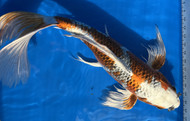
When evaluating a longfin koi, the eye is naturally drawn first to the pectoral fins. For this reason, finnage receives the greatest emphasis in judging.
High-quality longfin koi exhibit:
-
Pectoral fins that are proportional to the body
-
Evenly matched fins on both sides
-
Fins that are full, well-supported, and not excessively thin
-
Natural, graceful flow rather than stiffness or collapse
A critical structural element is the “shoulder” of the pectoral fin. This is the section where the fin extends outward from the body before flowing back. A well-developed shoulder allows the fin to be carried almost perpendicular to the body, supporting smooth swimming motion and visual balance. Without it, fins may twist, fold, or collapse against the body.
Tail fins should also be proportional. A tail that is dramatically longer than the pectorals—or noticeably shorter—creates imbalance and detracts from the fish’s overall presentation.
Identifiable Variety Matters
After finnage, judges look for an identifiable koi variety. Longfin koi are expected to clearly resemble recognized varieties such as Kohaku, Sanke, Showa, Ogon, Asagi, and others.
Clear variety identification:
-
Reinforces longfin koi as a refined form of Nishikigoi
-
Encourages disciplined breeding goals
-
Helps ensure consistency in judging and competition
Fish that lack recognizable variety characteristics may be visually interesting, but they are less competitive in formal judging.
Conformation: Supporting the Fins
While fins draw attention, the body must support them.
Good longfin conformation closely resembles that of traditional koi:
-
A strong, streamlined body
-
Adequate volume and thickness
-
Smooth transition from head to tail
-
No excessive thinness or weak tail joints
A common deficiency in longfin koi is a thin body paired with long fins. This combination creates a fragile appearance and often results in poor swimming motion. A robust body with proportionate fins produces a far more pleasing and durable fish.
Color and Pattern
Color quality remains important in longfin koi and follows the same expectations as traditional koi:
-
Even, well-developed pigmentation
-
Clean white ground where applicable
-
No washed-out or uneven areas of color
Pattern is considered, but it is less important than finnage, conformation, and color. Clean edges and clarity are preferred, but pattern alone will not compensate for structural or fin-related weaknesses.
Deportment: Movement Completes the Picture
Deportment refers to how the fish swims. High-quality longfin koi move with a graceful, fluid motion that complements their fins.
Poor deportment may include:
-
Jerky or uneven swimming
-
Fins collapsing during motion
-
Lack of control or balance in the water
These issues are often linked to structural fin problems, particularly weak pectoral shoulders.
Young vs. Mature Longfin Koi
Judging emphasis changes as longfin koi mature.
For younger fish, more weight is placed on:
-
Finnage development
-
Color quality
-
Overall balance
Conformation is evaluated with the understanding that body volume will continue to develop.
For mature fish, greater emphasis is placed on:
-
Body conformation
-
Strength and proportion
-
Overall presence and stability
Understanding this progression helps hobbyists make better long-term purchasing decisions.
Why These Standards Matter
Clear judging standards benefit the entire koi community. They:
-
Help hobbyists select healthier, better-balanced fish
-
Guide breeders toward sustainable improvement
-
Elevate longfin koi from novelty status to refined variety
-
Promote consistency in shows and exhibitions
Longfin koi are most beautiful when elegance, proportion, and movement work together.
Download the Complete Longfin Judging Guide (PDF)
This article provides a high-level overview of longfin koi judging principles. For those seeking a deeper, illustrated reference—including detailed examples of correct and incorrect finnage, body structure, and proportion—the complete judging guide is available below.
[Download the full Longfin Koi Judging Guide (PDF)]
This comprehensive document was developed with direct involvement from Kloubec Koi Farm and reflects years of experience evaluating and refining longfin koi standards.